Monday, October 16, 2023

The Value of Peer-Reviewed Journals

Peer-reviewed or refereed journals are a crucial part of the scholarly communication process. Submission to these journals represents an endorsement of the quality, validity and originality of academic research. The peer-review process is a rigorous evaluation to ensure work meets standards of methodology, relevance, and ethics. 

Peer-review involves subjecting the author’s scholarly work, research or ideas to the scrutiny of others who are experts in the field prior to publication. This critical assessment aims to filter out invalid or poor quality research. A submitted manuscript is first examined by the journal editor to evaluate if it aligns with the aim and scope of the journal. If so, it is sent to expert reviewers knowledgeable about the research area. 

Typically, two or three reviewers are selected to provide unbiased criticism regarding the work’s methodology, literature review, interpretation of results and originality of conclusions. Based on the feedback, the editor determines whether to reject the manuscript, accept it or communicate required modifications to the author. Most articles go through multiple rounds of revision based on reviewer comments to improve quality.

Through this rigorous peer-evaluation, the journal upholds high academic standards, maintains its reputation and ensures the quality of scientific communication. Published papers earn professional recognition, impact research progress, and allow integration of findings into the accepted body of knowledge within that field. Peer-review also acts as a quality check by identifying work that uses questionable research practices.

While a slow and cumbersome process, peer-review remains essential to scholarly integrity in the age of predatory publishers and rampant misinformation. It may have limitations but continues to be the gold standard for validating academic work. Peer-reviewed journals provide a trustworthy outlet for researchers to contribute meaningful work that stands up to expert evaluation.

Friday, January 1, 2021

Perspective study of investigating some medicinal plants in boosting the immune system against COVID-19: A Review

In the current scenario, the world is facing an unprecedented pandemic of COVID 19 due to SARS-COV 2. There is a growing interest in the use of these medicinal plants as complex immune system modulators. Lack of potential antiviral drugs/vaccines against this highly infectious lethal infection can be offered substantial therapeutic support by evaluating possible natural plant sources that can help to improve the immune system against this virus. This review can be used as a reference to traditional medicine in the alternative treatment of COVID-19 with the use of medicinal plants.

Tuesday, December 29, 2020

Importance, Problems and Limitations of Organic Farming in India

Organic farming is a production system which avoids the use of synthetically compounded fertilizers, pesticides and growth regulators. This system relies upon crop rotations, use of crop residues, animal manures, legumes, green manures and biofertilizers. The modern system of farming is becoming unsustainable as evidenced by damage to environment, chemical contaminations and health hazards, etc. The necessity of having an alternative agriculture method which can function in a friendly eco-system. Organic farming is recognized as the best known alternative to the conventional agriculture. India has a rich history of organic farming and the increasing domestic market of organic food can provide the necessary drive to the organic movement. Organic farming has several advantages over the conventional one apart from the protection of both the environment and human health. Improved soil fertility, better water quality, prevention of soil erosion, generation of rural employment, etc. are some of them. Here we are discussing in this article, to explain organic farming for improving human race and nature by maintaining sustainable agroecosystem along with its relevance, problems and constraints in India. 

Sunday, March 15, 2020

Good Laboratory Practices- An Overview of Its Various Working Areas

Good laboratory practices also abbreviated as GLP is one of the indispensable areas of any organisation that is meant to look after the quality working under framed guidelines, rules and regulations by regulatory authorities. The GLP draft was designed in 1976 and became the enforced regulation of USA from 1979

Tuesday, January 1, 2019

Season's Greetings and best wishes for the New Year 2019

On the occasion of New Year, we extend our heartiest greetings and best wishes to all readers, authors, editors, reviewers and all associated persons.


Best Regards
Editor

Sunday, December 16, 2018

Managing Emotions: Relationships among Expressive Writing and Emotional Intelligence

Professionals in human services can face emotionally challenging situations in their work settings. Staying balanced, when encountering emotional issues, is a desired capacity for human services providers.  Emotional intelligence has been found to positively influence people's abilities to manage emotions as well as general well-being and health.  Expressive writing can also help human service providers to regulate and process emotions potentially increasing emotional intelligence. The purpose of the study was to investigate the relationships of negative emotions, shyness, emotionally expressive writing and emotional intelligence among undergraduate rehabilitative services students and related majors. Results showed significant moderate inverse correlations between  emotional factors of optimism, depression, and stress with emotional intelligence.  Similarly, expressive writing was positively correlated with social skills, reader consciousness and conflict resolution. Recommendations for human services providers training programs are discussed  with regards to enhancing areas of student emotional intelligence.  Emotional intelligence as a skill may improve  services delivery for human services clients.

Saturday, December 15, 2018

Publication Ethics and Publication Malpractice Statement

For updated statement visit : http://pubs.iscience.in/journal/index.php/ira/about/editorialPolicies#custom-0
The Journal and its Publisher ‘Integrated Science’ follows the best practices in evaluation of contents, processing of manuscripts and publishing thereof. The Journal and Publisher essentially follows the code of conduct defined by Committee on Publication Ethics (COPE) for Journal Editors (Code of Conduct and Best Practices Guidelines for Journal Editors listed in COPE guidelines file: http://publicationethics.org/files/Code%20of%20Conduct_2.pdf  ) and Publisher (the Code of Conduct Journal Publishers  listed in COPE page file: http://publicationethics.org/files/Code%20of%20conduct%20for%20publishers%20FINAL_1_0_0.pdf
Further, the journal publishes biomedical reports, so the journal adheres and follows the guidelines defined for publication in medical journals by International Committee of Medical Journal Editors (ICMJE) in its document ‘Recommendations for the Conduct, Reporting, Editing and Publication of Scholarly Work in Medical Journals’ provided on link http://www.icmje.org/recommendations  and World Association of Medical Editors (WAME) on its webpage http://www.wame.org/
The Authors, Reviewers and Editors are expected to adhere and follow the code of conduct on ethical practices defined at above mentioned links in the respective roles.

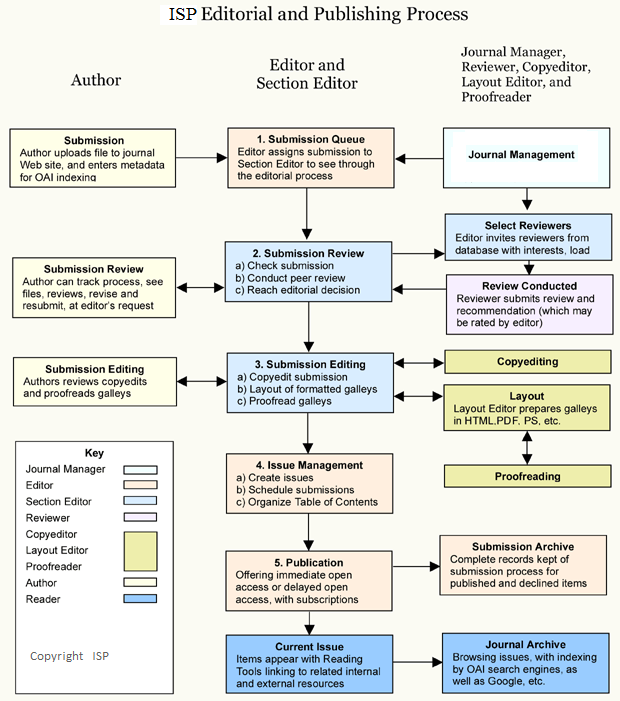
The manuscript processing involves following stages
In addition, general instructions and help pages on ‘Integrated Science’ for Authors, Reviewers and Editors should be referred for brief general conduct   
Authors
Each authors who submit (and willing to publish in the journal) the manuscript, should read the ethical guidelines for submission and publication of work in scientific and medical journal (listed on above links). Particularly, manuscript must be plagiarism free. Any Animal study reported should have been performed with approval of respective institutional ethical committee and statement thereof should be included in manuscript.
Author Guidelines for manuscript preparation and submission: http://pubs.iscience.in/journal/index.php/cbl/about/submission  
General Help pages for Authors: http://pubs.iscience.in/authors 
Reviewer
The journal uses ‘Single Blind Review’ of the manuscripts, the reviewers must maintain the confidentiality during reviewing and post review of manuscript. The manuscript work should be evaluated in respective field of expertise and detailed feedback and recommendation should be provided to editors. The general code of conduct defined in above links should be referred and followed while reviewing and providing feedback.
Basic Ethics for Reviewers are noted at: http://pubs.iscience.in/reviewer

Editors
All the editors should handle the assigned manuscripts by observing fair processing of submissions, editorial independence, confidentiality, and rational decision making within stipulated time framework with the feedback obtained from independent reviewer/experts in the field of work covered in respective manuscript. A detailed code of conduct mentioned in above reference documents should be adhered to.
General help page for Editors (for using the online software/editorial processing): http://pubs.iscience.in/editor

Publishers
The Publisher ‘Integrated Science’ handles the unethical publishing cases. In cases of alleged or proven scientific misconduct, fraudulent publication or plagiarism, the publisher, in close collaboration with the editors, will take all appropriate measures to clarify the situation and to amend the article in question. This includes the prompt publication of an erratum, clarification or, in the most severe case, the retraction of the affected work.  The publisher, together with the editors, shall take reasonable steps to identify and prevent the publication of papers where research misconduct has occurred, and under no circumstances encourage such misconduct or knowingly allow such misconduct to take place.
Access to journal contentThe publisher is committed to the permanent availability and preservation of scholarly research. The online and digital contents are preserved by the Publisher by maintaining own digital archive and would also ensure accessibility by partnering with other digital archiving organizations. Most of the journal contents are archived in the Print form as well.

Tuesday, October 23, 2018

Reviewer Recognition

Publons works with reviewers, publishers, universities, and funding agencies to turn peer review into a measurable research output. 
Collect your peer review information on Publons to produce a comprehensive reviewer profile with publisher-verified peer review contributions which you can then add to your resume.
Sign up today at https://publons.com

What is Publons?

Publons helps you to record, verify, and showcase your peer review contributions for use in promotion applications. You get recognition even if your reviews are anonymous and the manuscript is never published.
Take a look at a Publons reviewer profile or browse  top reviewers if you want to learn more. If you'd like to get a head start on your reviewer profile, create an account now (it's free).
Publons gives recognition for peer review without compromising reviewer anonymity or infringing upon journal policies. By default, the content of the review will not be publicly displayed, and only the year of the review and the journal title will be shown on reviewer profiles. You may edit what is displayed for any review or opt out of the service at any time.


.

Sunday, October 14, 2018

Microbiological quality assessment of fast food available near MMU campus Mullana

Microbial food contamination is a serious concern to the mankind as it attributes to various foodborne diseases. Million of peoples worldwide are known to be afflicted with diseases associated with foodborne pathogens. Keeping in view of these facts we investigated multiple fast food samples for the assessment of microbial contamination. Spring Rolls and Chowmein were reported to have highest bacterial load ranging from 105 to 106 cfu/ml amongest all the samples studied. Samples like Bhel-Puri and Pani-Puri, had relatively low bacterial counts in the range of 102 to 104 cfu/ml. Biochemical tests further confirmed the presence of Bacillus sp. and Klebsiella sp. in Spring Roll sample while Escherichia coli  in Chowmein sample. Bhel Puri and Pani Puri samples had the predominance of Salmonella sp.  However, the Burger, and the Samosa samples were found to be contaminated with Pseudomonas sp and Enterobacter sp respectively. Besides, coliform bacteria reported to be present in Pani-Puri sample. These aforementioned aspects clearly indicate the pre-assessment and awareness of potential sources of food contamination for a good nutrition.

Friday, October 5, 2018

Recent advances in β-lactam chemistry

Beta-lactams are one of the essential heterocycles which have saved humans from deadly infections. Over the years many methods have been developed. This review classifies various methods based on reagents and reactions. It has been concluded that Ketene−Imine Staudinger Reaction is the method of choice.

Thursday, September 20, 2018

Certain results on entire functions defined by bicomplex Dirichlet series

In this work, we have introduced and studied the Bicomplex version of Complex Dirichlet Series  . We have derived condition for which the sum function of the Bicomplex Dirichlet Series represents an entire function. The Entireness of sum and Hadamard product of two Entire Bicomplex Dirichlet Series are also discussed.

Friday, June 29, 2018

Fabrication and characterization of carbon nanotubes-based Polymer nanocomposites

Polymer nanocomposites are used in different application such as load bearing, aerospace and biomedical etc. Present work describes the fabrication and preparation of carbon nanotubes based polymer nanocomposites by an injection molding machine. Multi walled carbon nanotubes reinforcement was mixed with pure polymer (high density polyethylene) of injection moulding grade matrix. The resultant matrix shows remarkable strength as compare to pure material due to material behaves like as composites. The carbon nano fluid was mixed with HDPE pellets for CNT coated HD PE pellets. This coated pellets used as raw material for an injection molding to form “dog bone shaped” CNT/HDPE tensile specimens of  dimensions 120 mm long, 2 mm thick according to ASTM. Different weight fraction of CNT were mixed with pure material and improvement in the strength, toughness, young modulus, stiffness etc. were studied using universal testing machines, Scanning electron microscopy and optical microscopic. It was concluded that the composites have higher mechanical properties compared to pure material.

Monday, May 21, 2018

Medicinal plants as hepatoprotective agents in Indian systems of medicine: A review

Author: Anjana Jadon

Liver is a most important organ of the body. It plays an important role to maintaining various physiological processes in the body. It is involved in several vital functions, such as metabolism, secretion and storage. It plays a central role in the detoxification and excretion of many exogenous and endogenous compounds. Hence, any injury or impairment of its function has grave implications for the health of the affected person. Many more drugs or therapies are available for the treatment of hepatic disorders, but still there is a need for the novel drug discovery which can target multiple disease pathways. In the 21st century has a great that paradigm shift towards therapeutic evaluation of herbal products. The use of herbal products has a great role in the treatment of liver diseases and has no side effects. There are a number of hepatoprotective plants have been reported. In this review article, effort has been taken to collect and compile the details of hepatoprotective plants, which will be helpful in the field of Indian system of medicines.

Tuesday, March 6, 2018

PASSIVE OPTICAL NETWORKS: A FUTURESTIC APPROACH

This paper is to know about the meaning of passive optical network`s and its architecture. It explains the different types of passive optical networks and its uses for the present as well as future of the communication. Passive optical networks provide the huge bandwidth for the data transmission for triple play (video-voice-data) simultaneously. Requirement for the high speed communication networks is the high bandwidth for the data transmission without interruption. Passive optical networks provide this facility very effectively.

Read More

Saturday, February 3, 2018

Isolation and screening of thermophilic lignolytic bacterial strains for lignin degrading enzymes

In the present investigation, total twenty two thermophilic lignolytic bacterial cultures were isolated from various sources using Nutrient Agar (NA) and Minimal Salt Medium (MSM) medium with Lignin Alkali (1.0 g/L) by incubating at pH 7 and 50°C for 48 hrs. These isolates were characterized by special reference to their ability towards wide temperature, pH resilience and generation of thermophilic enzymes. For the screening and studying lignin degrading potential, these microbes were grown on MSM agar plates with Methylene Blue dye (0.25g/L). After the incubation time of 48 hrs, these plates were observed for clear (halo) zones form around the streaked strain. Only 5 strains were showing such clear (halo) zones which indicates their potential for degrading lignin.  These screened isolates were then used for further experimental work. 


Read More

Assessment of Water Quality using Pollution-Index in the study stretch of River Chambal, India

The present study is intended to ascertain the quality of water for public consumption and other life supporting activities by way of assessing pollution indices such as Carlson’s trophic state index (C-TSI), eutrophication index (EI), organic pollution index (OPI) and comprehensive pollution index (CPI).The study has been carried out for ten different sites in River Chambal of Madhya Pradesh, India, during pre and post-monsoon 2014. This paper deals with the study on – “How environmental parameters impacts/affects the quality of river water”. In this study, four pollution indices have been determined on the basis of 16physico-chemical parameters, which indicates that the River Chambal  comes under the category of clear (CPI<0.8), oligotrophic (C-TSI<30-40), no eutrophication (EI<1) and excellent water quality (OPI<0). Results also show that the river water is suitable for irrigation and life supporting for flora and fauna. With slight treatment, the water can be made available for drinking as well. The present study shows that EI and OPI index are the best parameters to assess water quality since it gives precise results based on four water quality parameters.


Read More

IRA is indexed in Scientific Indexing Services (SIS)

Integrated Research Advances (IRA) journal 
Integrated Research Advances, ISSN: 2456-334X

Integrated Research Advances (IRA) is a biannual and online international multidisciplinary peer-reviewed, and refereed  research journal. Integrated Research Advances Journal publishes research articles, short communications, review articles, mini-reviews, insights from all branches of Science and Technology including Engineering, Medical, Dental & Pharmaceutical Sciences, Instruments development, analytical tools, Education, Arts and Social Sciences. The journal dedicated for the promotion and dissemination of knowledge. We accept research papers in multidisciplinary areas of research. There is no processing fee for accepted papers. The authors of the accepted papers will have to transfer the copy right to journal in through duly signed copy right transfer form available on website.  Authors should send their request for open access publication to Managing Editor (pubs@iscience.in). The journal publishes articles from all branches of science and technology.

The journal has been indexed by several indexing and abstracting agencies. This year Scientific Indexing Services (SIS) is also started indexing the journal. We thanks all the editorial members, Authors, and readers for their valuable contribution.
.
The details are available here https://www.sindexs.org/JournalList.aspx?ID=4569


Friday, December 22, 2017

Comprehensive Review on Enabling Reactivity Controlled Compression Ignition (RCCI) in Diesel Engines

The demand for higher fuel economy and lower exhaust gas emissions of CI engine cannot be achieved by just using mechanically governed fuel injection systems. The electronically operated fuel injection system is the heart of a CI engine and has become one of the essential technologies to control critical in the recent years. High computing power of microcontrollers has made it possible for controlling injection of fuel electronically at any injection pressure, any crank angle and for any duration during the engine operation. A newer concept of RCCI operation further reduces the particulate matter and NOx emission to almost zero level with slightly higher BTE. Hence, there is a need to discuss the performance, combustion and emission of RCCI engine fuelled with alternative fuels and this paper presents an exhaustive review on these aspects. 


Read More

Friday, November 3, 2017

A literature Review on physiotherapeutic interventions for airway clearance in COPD patients

Chronic obstructive pulmonary disease (COPD) is internationally preferred term encompassing chronic bronchitis, asthma and emphysema. Chronic obstructive pulmonary disease (COPD) is characterized by airflow obstruction with breathing-related symptoms such as chronic cough, exertional dyspnea, expectoration, and wheeze. These symptoms may occur in conjunction with airway hyper responsiveness and may be partially reversible. Obstructive lung disease includes Chronic bronchitis, Emphysema, Asthma, Bronchiectasis and Cystic fibrosis. The result of the present narrative review concluded the effectiveness of Active cycle of breathing technique, Diaphragmatic breathing exercise along with Postural drainage in Chronic Obstructive lung disease in order to achieve the significant improvement and hasten the recovery of the patients.


Read More